Musa sp
The banana.
What an amazing plant. It’s up there with coconuts and bamboo as being one of
the plants with the most varied uses in the world. It provides nutritious food,
natural packaging, plates, umberellas, medicine,mulch and so much more. What more could you
ask from a plant?
Musa species
|
Banana, Pisang,
Plantain, Saba
|
FAMILY
|
|
Identification
Herbaceous perennial often grown as an annual. This plant can grow up
to 7m.
Leaves spirally arranged around pseudostem, pinnate venation.
|
Cultivation
Widely cultivated throughout the world, this plant prefers warm
climates, full sun and abundant moisture.
|
Flowers My plants are
fruiting atm (July)
|
Fruits My plants have
fruit atm
|
Etymology
|
Warning
Sap permanently stains clothing
|
Edibility
Fruit raw or cooked
Leaf used to cook food in
|
Medicinal Uses
Headaches, Alopecia, Burns, Bites, Cancer, Diabetes, Epilepsy, Diarrhoea, Fever, Dyssentry, Fractures, Gangrene, Migraine, Nausea and more
|


The banana
plant has been in cultivation for many years, and the cultivated variety is
sterile, producing no seed. The wild bananas that still grow in
tropical-subtropical countries produce numerous seed.
Fruit is
edible cooked in its green immature stage, or either raw or cooked in its yellow
mature stage. The colour of the skin varies with the type of banana, with ‘Blue
Java/Ash Plantain’ having a distinct blue tinge to the immature fruit (although
ripe fruit is still yellow), and ‘Red Dacca’ having a permanent deep red/maroon
skin (although the inside flesh is deep yellow to orange).
 |
| 'Saba' variety |
 |
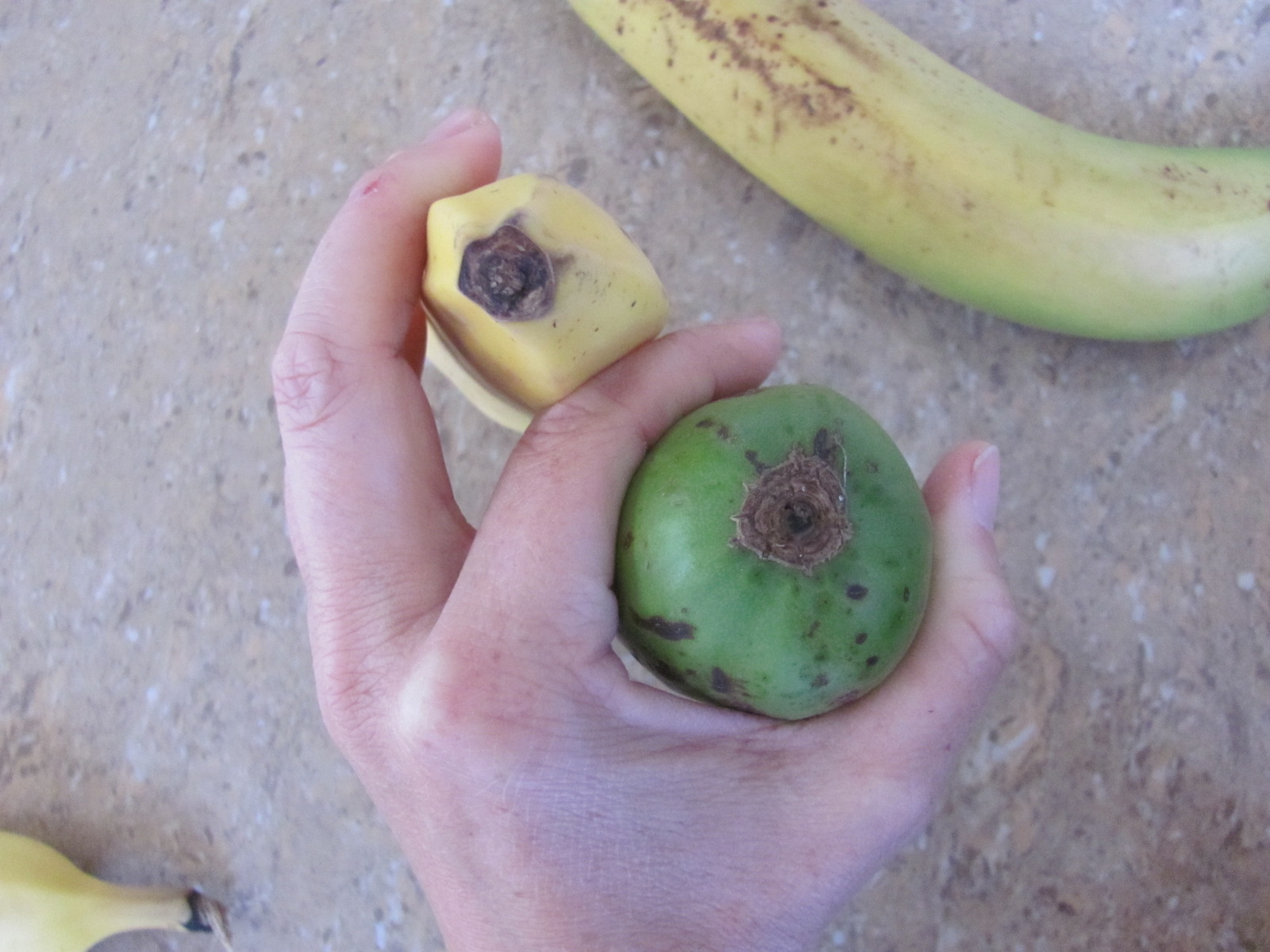
| 'Saba' Left; 'Ladyfinger' Middle; 'Cavendish' Right |
 |
| 'Ladyfinger' Left; 'Saba' Right |
One of my
favourite bananas for flavour and texture is what I think is called ‘Saba’,
although I am not sure. It can be eaten raw when ripe, or cooked when green.
Simply peel the green bananas, boil, mash, mix with grated ginger, garlic and
eschallot/onion, form into cakes and pan fry. Delicious. Cooked green banana
tastes somewhat like cooked potato.
 |
| Flesh of the Saba banana is a rich warm yellow colour |
 |
| Peel and chop |
 |
| Add to pan of hot water |
 |
| Boil until softish |
 |
| Add grated garlic, ginger, onion then mash |
 |
| Shape into cakes, fry |
 |
| Serve! |
Musa has
medicinal qualities also, with the whole plant being used in some way. The root
has been as anthelmintic (to kill intestinal worms) and for reducing
bronchocele. The fruit is eaten to prevent and cure stomach ulcers, in
combination with pineapple, blueberries, cloves, ginger and cinnamon. The peel
and pulp of ripe banana have both antifungal and antibiotic activity, and the
unripe banana fruit has antimicrobial/antibiotic activity (Fagbemi et al, 2009).
A stem
maceration is given orally for the treatment of diabetes in Cuba, also a
decoction of the root is given orally for the treatment of unspecified venereal
diseases. The same paper reports an unusual method of treating earache, that of
frying the leaves and applying topically (Cano & Volpato, 2004).
 |
| Flower |
 |
| Fruit |
Musa paradisiacal
has been used to treat alopecia (female), headache, burns, bites (snake, dog,
spider), cancer (nose), diarrhoea, dysentry, epilepsy, fever, fractures,
gangrene, migraines, nausea, smallpox and numerous other diseases. Finding
details of how the remedies were prepared for each specific ailment is
extremely time consuming, as it involves trawling through vast numbers of
journal articles, but as I find records of use, I will add them here. If you
have a particular query, just leave a comment and I will see what I can find.
 |
| Young plant grown from tissue culture |
 |
| Young plants |
References
Cano, J. & Volpato, G. Herbal mixtures in the traditional
medicine of Eastern Cuba. Journal of Ethnopharmacology 90:293-316
Fagbemi, J., Ugoji, E., Tayo, A. & Adelowotan,
O. 2009. Evaluation of the antimicrobial properties of unripe banana (Musa
sapientum L.), lemon grass (Cymbopogon citratus S.) and turmeric (Curcuma
longac L.) on pathogens. African Journal of Biotechnology 8 (7): 1176-1182
|
